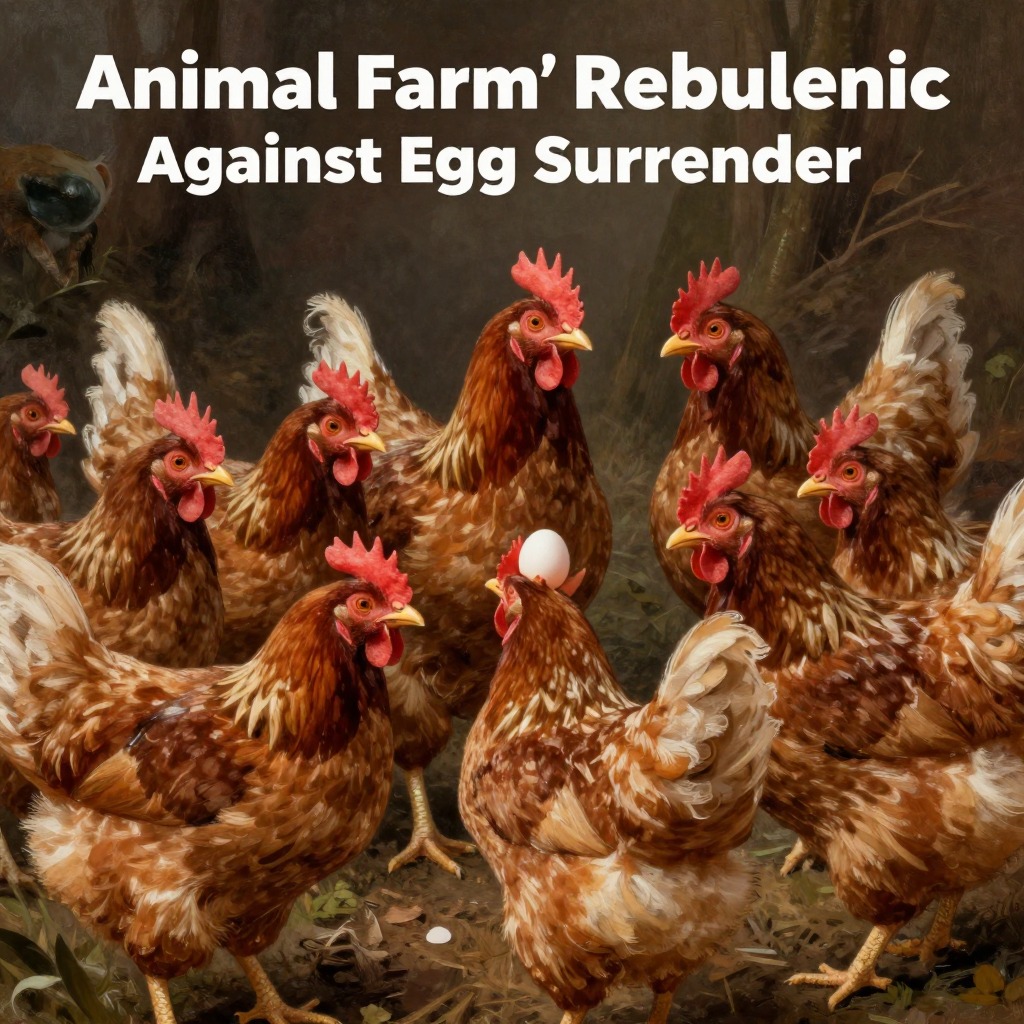
Eggs must be surrendered
The rule that eggs must be surrendered to be sold to humans represents a pivotal moment in Animal Farm's descent from revolutionary idealism to exploitative tyranny, as the pigs force the hens to give up their eggs for trade with the outside world, triggering the first open rebellion since the expulsion of Mr. Jones and revealing the regime's willingness to sacrifice its own members for economic gain.
Origins and Justification
The policy of selling eggs emerged from the farm's growing economic desperation. By late January, food shortages had become critical, with the corn ration drastically reduced and most of the potato crop ruined by frost. Napoleon, rarely appearing in public and guarded by fierce dogs, decided through his intermediary Mr. Whymper to accept a contract for four hundred eggs a week. The price of these eggs, he announced, would pay for enough grain and meal to keep the farm going until summer. The hens, who had just come into lay again, were told they must surrender their eggs. This was not the first time the pigs had appropriated the produce of others for their own purposes: earlier, milk and apples had been reserved for the pigs alone, justified by Squealer's argument that these were necessary for the brainworkers who managed the farm. The egg contract extended this logic, framing the hens' sacrifice as their own special contribution to the building of the windmill.
The Hens' Rebellion and Its Suppression
When the hens heard the announcement, they raised a terrible outcry. They had been warned earlier that this sacrifice might be necessary but had not believed it would really happen. Just as they were getting their clutches ready for the spring sitting, they protested that to take the eggs away now was murder. For the first time since the expulsion of Jones, something resembling a rebellion occurred. Led by three young Black Minorca pullets, the hens made a determined effort to thwart Napoleon's wishes by flying up to the rafters and laying their eggs there, smashing them to pieces on the floor. Napoleon acted swiftly and ruthlessly. He ordered the hens' rations to be stopped and decreed that any animal giving so much as a grain of corn to a hen should be punished by death. The dogs saw to it that these orders were carried out. For five days the hens held out, then they capitulated and went back to their nesting boxes. Nine hens had died in the meantime. Their bodies were buried in the orchard, and it was given out that they had died of coccidiosis. Whymper heard nothing of this affair, and the eggs were duly delivered, a grocer's van driving up to the farm once a week to take them away.
Escalation and Consequences
The egg contract did not remain static. As the farm's financial needs grew, the quota was increased to six hundred eggs a week, so that that year the hens barely hatched enough chicks to keep their numbers at the same level. The surrender of eggs became a permanent feature of farm life, a routine sacrifice demanded by the pigs' economic priorities. The hens' rebellion, though crushed, set a precedent for the regime's willingness to use lethal force against its own members. The nine hens who died were the first casualties of internal conflict since the expulsion of Jones, foreshadowing the far larger purge that would follow, when Napoleon's dogs tore the throats out of animals accused of collaborating with Snowball. The egg rule also demonstrated how the pigs' control over the farm's resources extended to the very bodies and reproductive labor of the other animals, transforming the hens' natural cycle of laying and hatching into a commodity to be sold for the regime's benefit.
Thematic Significance
The rule that eggs must be surrendered encapsulates the betrayal of the original principles of Animalism. The Seven Commandments had promised that all animals were equal and that no animal should tyrannise over his own kind. Yet the pigs, who had once argued that milk and apples were necessary for their health as brainworkers, now demanded the eggs of the hens—not for their own consumption, but for sale to the very human beings the Rebellion had been fought to overthrow. The hens' rebellion was the first time the animals openly resisted the pigs' authority, and its violent suppression marked a turning point: the regime would no longer rely on persuasion and Squealer's rhetoric alone, but on the threat of starvation and death. The egg contract also revealed the economic logic that would come to dominate Animal Farm: the needs of the windmill and the pigs' ambitions overrode the welfare of the other animals, and any who objected would be crushed. The rule thus stands as a clear example of how revolutionary ideals are sacrificed to practical expediency, and how the pigs, in their pursuit of power and comfort, came to resemble the very humans they had expelled.